cDNA Microarray Technology and Its Applications in Modern Molecular Biology and Clinical Research
1. Introduction
The development of a complete human organism from a single fertilized cell into a fully functional adult body is one of the most complex biological processes known. This transformation depends on the coordinated activity of approximately 100,000 genes, each of which must be expressed at precise levels, times, and locations. The sequencing of the human genome, which revealed roughly three billion base pairs, marked a major milestone in biology. However, understanding how genes interact and function collectively remains a major scientific challenge.
To fully comprehend biological processes such as development, disease progression, and cellular regulation, scientists must analyze gene expression patterns across different tissues and physiological conditions. Traditionally, studying gene expression was limited to examining one gene at a time, which was inefficient and insufficient for understanding complex biological systems. The emergence of cDNA microarray technology revolutionized this field by enabling the simultaneous monitoring of thousands of genes.
Since its introduction in the mid-1990s by Patrick Brown and colleagues, cDNA microarrays have become a fundamental tool in molecular biology and clinical diagnostics. This technology allows researchers to study gene expression profiles on a large scale, offering insights into disease mechanisms, gene regulation, and therapeutic targets.
Two main types of microarrays exist: cDNA microarrays and oligonucleotide arrays. This discussion focuses specifically on cDNA microarrays, particularly those fabricated on glass slides, due to their widespread use and technical advantages.

2. Biological Basis of cDNA Microarray Technology
Living cells rely on their ability to store, process, and utilize genetic information. This information is encoded in DNA and expressed through RNA and proteins. Among these, messenger RNA (mRNA) plays a critical role as it carries genetic instructions from DNA to the cellular machinery responsible for protein synthesis.
The quantity of mRNA present in a cell reflects the activity level of specific genes. Therefore, measuring mRNA levels provides a snapshot of gene expression under particular conditions. In human cells, thousands of genes are expressed simultaneously, and their expression levels change dynamically in response to environmental signals, developmental stages, or disease states.
For example, during viral infection, host cells undergo significant changes in gene expression to either combat the virus or, in some cases, to facilitate viral replication. These changes can be detected by comparing mRNA levels between healthy and infected cells. Such comparisons generate gene expression profiles, which can act as molecular “fingerprints” for specific biological conditions.
cDNA microarrays enable this type of large-scale analysis by allowing researchers to measure the expression of thousands of genes simultaneously. This capability is particularly useful for identifying genes involved in diseases, understanding cellular responses, and discovering potential therapeutic targets.
3. Bioinformatics in cDNA Microarray Analysis
The widespread adoption of microarray technology has led to the generation of massive datasets, requiring advanced computational tools for analysis. This has driven the development of bioinformatics, an interdisciplinary field combining biology, computer science, and statistics.
3.1 Laboratory Information Management Systems (LIMS)
A key component of microarray research is the management of experimental data. Laboratory Information Management Systems (LIMS) are designed to track samples, experimental conditions, and results. Databases such as ArrayDB store detailed information about microarray experiments, including gene identities, probe characteristics, and hybridization results.
These systems facilitate data organization, retrieval, and sharing, enabling researchers to perform comparative analyses across multiple experiments.
3.2 Microarray Image Analysis
After hybridization, microarray slides are scanned to produce images representing gene expression levels. Image analysis involves several steps:
- Detection of individual DNA spots on the array
- Measurement of fluorescence intensity
- Background correction
- Calculation of expression ratios
The accuracy of this process is critical, as it directly affects downstream data interpretation. Advanced software tools are used to automate these steps and ensure consistency.
3.3 Gene Expression Profiling and Clustering
Once processed, gene expression data must be analyzed to identify patterns. Techniques such as clustering algorithms group genes with similar expression profiles, revealing functional relationships.
Methods like hierarchical clustering and k-means clustering help identify:
- Co-regulated genes
- Biological pathways
- Disease-specific expression patterns
Additionally, multidimensional scaling (MDS) is used to visualize similarities between samples, providing insights into biological relationships.
4. Fabrication of cDNA Microarrays
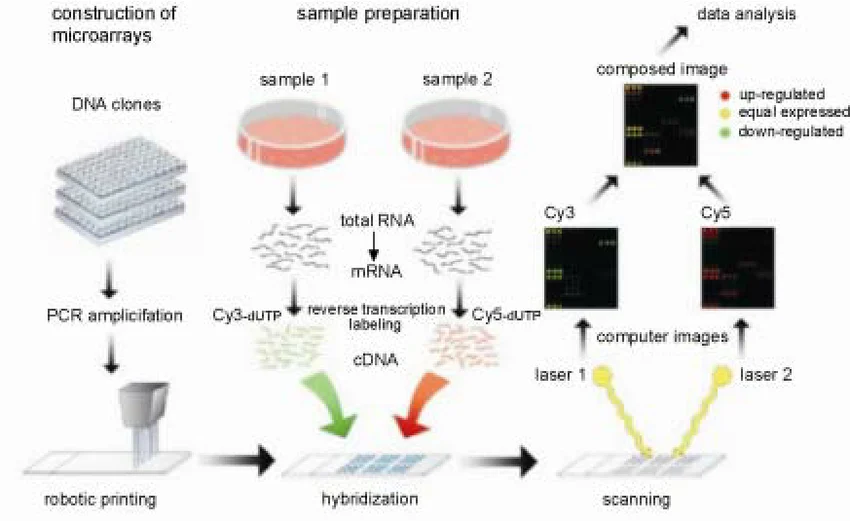
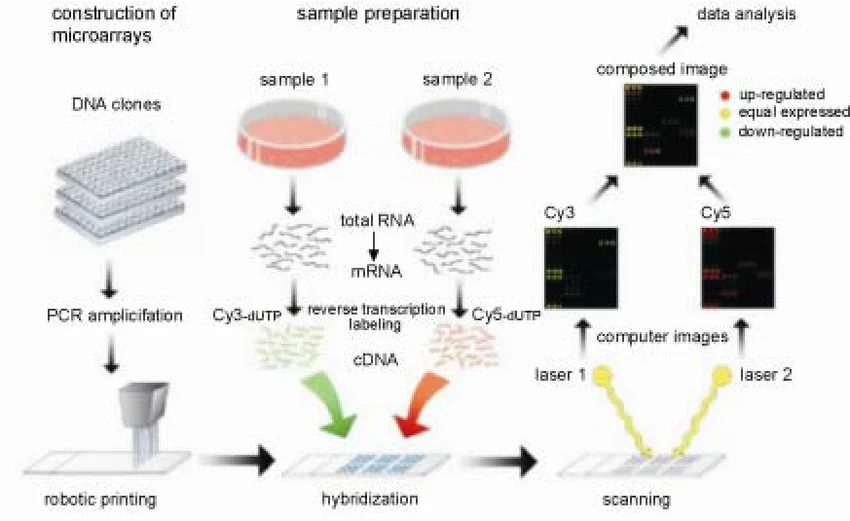
The construction of a cDNA microarray involves several technical steps. First, DNA fragments corresponding to genes of interest are selected, often from databases such as GenBank or UniGene. These fragments are amplified using polymerase chain reaction (PCR).
The amplified DNA is then deposited onto glass slides using robotic systems. Each spot on the slide represents a specific gene. The glass surface is chemically treated to ensure strong attachment of DNA molecules and to minimize background noise.
Robotic arrayers use fine probes, often referred to as “quill pins,” to transfer tiny volumes of DNA onto the slide with high precision. This process allows thousands of DNA samples to be arranged in an organized grid pattern.
Once deposited, the DNA is fixed onto the slide, creating a stable microarray ready for hybridization.
5. Probe Labeling and Hybridization
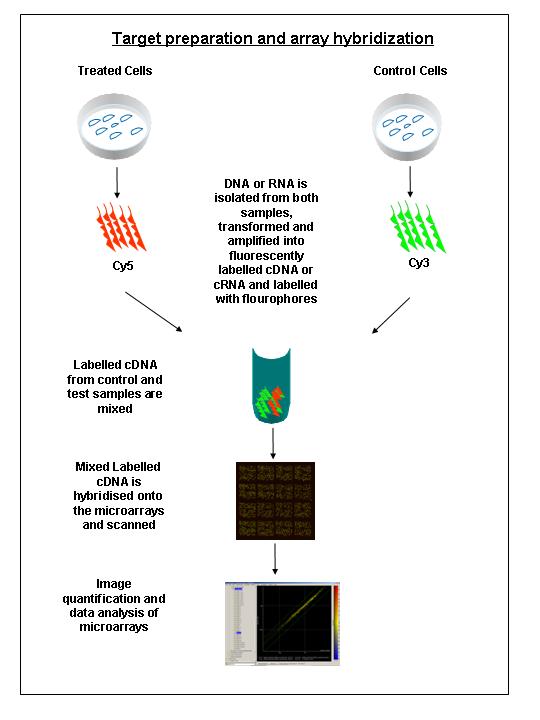
To measure gene expression, RNA is extracted from biological samples and converted into complementary DNA (cDNA). These cDNA molecules are labeled with fluorescent dyes.
Typically, two samples are compared simultaneously:
- A control sample ( healthy tissue)
- A test sample (diseased tissue)
Each sample is labeled with a different fluorescent dye. The labeled cDNAs are then hybridized to the microarray, where they bind to complementary DNA sequences.
After hybridization, unbound probes are washed away, and the slide is prepared for scanning.
6. Microarray Scanning and Data Acquisition
Microarray slides are scanned using specialized devices that function as laser-based fluorescence microscopes. These scanners detect fluorescent signals emitted by labeled cDNA molecules.
Each spot on the array produces a signal whose intensity reflects the expression level of the corresponding gene. By comparing signals from different samples, researchers can determine which genes are upregulated or downregulated.
The resulting data are processed using specialized software to generate quantitative expression profiles for thousands of genes simultaneously.
7. Applications of cDNA Microarray Technology
7.1 Gene Expression Analysis and Discovery
One of the most important applications of cDNA microarrays is the study of gene expression. Researchers can analyze thousands of genes in parallel, identifying those involved in specific biological processes or diseases.
For example, microarrays have been used to study cancer by comparing gene expression patterns between normal and tumor cells. This approach has led to the identification of genes associated with tumor growth, metastasis, and resistance to treatment.
Microarrays also enable the discovery of novel genes and previously unknown regulatory mechanisms, contributing significantly to our understanding of complex diseases.
7.2 Understanding Biological Pathways
cDNA microarrays are powerful tools for studying biochemical pathways. By analyzing gene expression changes under different conditions, researchers can map interactions between genes and identify key regulatory networks.
For instance, studies in yeast have demonstrated how gene expression changes during metabolic shifts, revealing how cells adapt to environmental changes. Similarly, microarrays have been used to study the cell cycle, identifying genes involved in cell division and growth control.
These insights are essential for understanding fundamental biological processes and developing new therapeutic strategies.
7.3 Disease Diagnosis and Biomarker Discovery
Microarrays play a crucial role in clinical diagnostics by enabling the identification of disease-specific gene expression patterns. These patterns can serve as biomarkers for early detection, diagnosis, and prognosis.
For example:
- Cancer classification based on gene expression profiles
- Identification of inflammatory disease markers
- Detection of genetic disorders
Such applications improve diagnostic accuracy and support personalized medicine approaches.
7.4 Drug Discovery and Development
In pharmaceutical research, cDNA microarrays are used to identify potential drug targets by analyzing gene expression changes associated with disease.
They are also used to evaluate the effects of drugs on gene expression, helping researchers understand mechanisms of action and identify potential side effects.
For example, the identification of specific enzymes involved in disease pathways has led to the development of targeted therapies. Microarrays thus accelerate drug discovery and improve the efficiency of therapeutic development.
7.5 Functional Genomics and Systems Biology
cDNA microarrays contribute to the field of functional genomics by linking gene expression to biological function. By analyzing large datasets, researchers can develop models of gene regulation and cellular behavior.
This systems-level understanding is essential for studying complex traits and diseases, where multiple genes interact in intricate networks.
8. Advantages of cDNA Microarray Technology
cDNA microarrays offer several important advantages:
- High-throughput analysis of thousands of genes
- Quantitative measurement of gene expression
- Ability to compare multiple samples simultaneously
- Cost-effective for large-scale studies
These features make microarrays a valuable tool in both research and clinical settings.
9. Limitations and Challenges
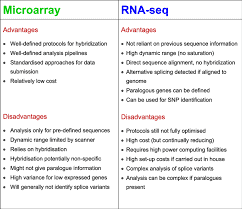
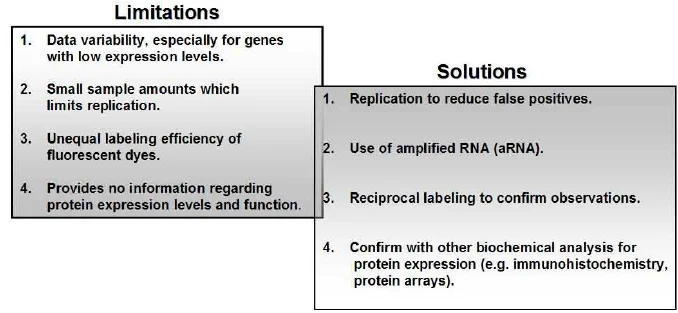
Despite its advantages, cDNA microarray technology has some limitations:
- Dependence on known gene sequences
- Limited sensitivity compared to newer technologies like RNA sequencing
- Complex data analysis requiring bioinformatics expertise
- Potential for experimental variability
These challenges have led to the development of complementary technologies, but microarrays remain widely used due to their reliability and efficiency.
10. Conclusion
cDNA microarray technology represents a major advancement in molecular biology, enabling large-scale analysis of gene expression and providing valuable insights into biological systems. From gene discovery to disease diagnosis and drug development, its applications are vast and impactful.
Although newer technologies such as next-generation sequencing are emerging, cDNA microarrays continue to play a critical role in research and clinical diagnostics. Their ability to generate comprehensive gene expression profiles makes them an essential tool for understanding complex biological processes.
As technology continues to evolve, cDNA microarrays are expected to remain a cornerstone of genomic research, bridging the gap between genetic information and clinical application.